
“An Accident of birth”
a Memoir by T. Alex Blum
When a stranger who turns out to be his niece receives an extra 23andMe test by mistake, it changes Alex Blum’s life forever.
At the age of sixty, Alex Blum made a life-altering discovery: he was the eldest of four biological brothers he never knew existed. Born in 1955, Blum had always known he was adopted, yet the secrecy of the era kept every detail of his origins sealed. Without a court order, he spent decades without a single clue about where he came from, or why he had been given up.
Raised by a wealthy family on Manhattan’s Upper East Side, Blum grew up surrounded by privilege but plagued by a deep sense of disconnection. He often felt out of place and emotionally unmoored, longing for a sense of belonging that never arrived.
Having built a career helping others tell their stories, first for brands as a commercial producer and then as a feature film producer with credits including Behind Enemy Lines and Flight of the Phoenix for 20th Century Fox—Blum finally turns the camera on himself in An Accident of Birth.
More than a memoir of adoption and reunion, An Accident of Birth explores the universal emotional landscape shared by adoptees everywhere. With candid, affecting prose, Blum examines the pressures of “adoptee gratitude,” the quiet ache of alienation, and the lifelong search for identity, connection, and home.
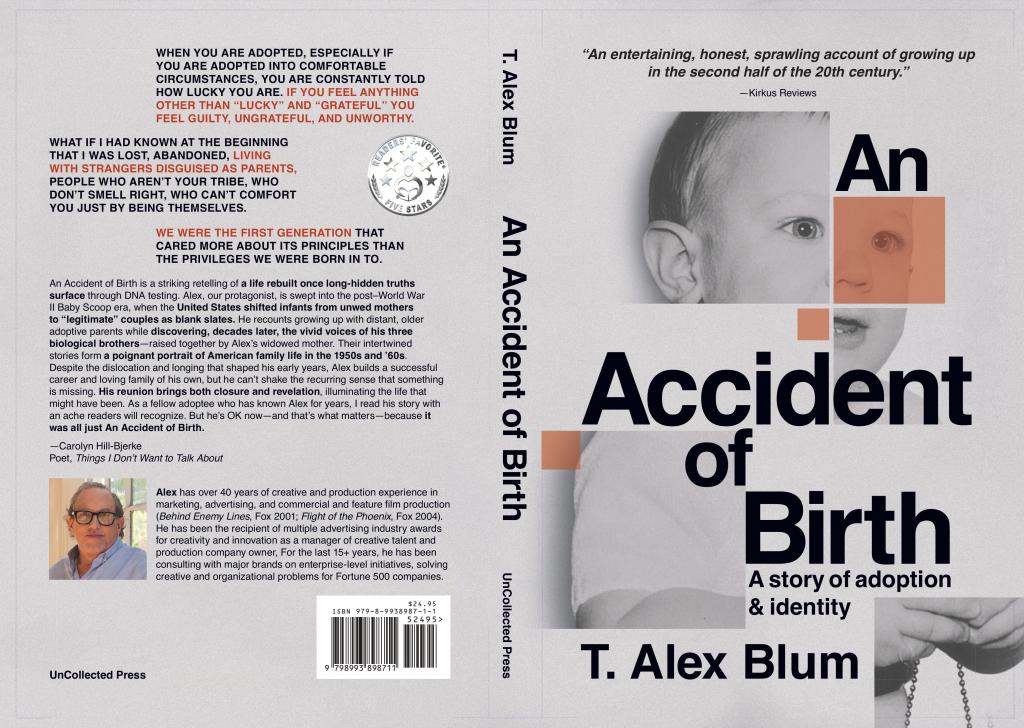
Kirkus Reviews
An extensive memoir chronicling one man’s American life.
Blum was born in 1955 and grew up on the Upper East Side of Manhattan. He was adopted at the age of four months, and his adoptive parents were well-to-do people about town: “It seemed like they were always dressing up in black tie to go somewhere, to a play, to Lincoln Center, or to a party, or a dinner”; they were not ones to “stay home and watch TV or play games with the kids.” He attended prestigious educational institutions like Choate and Pomfret. Times were changing, even at elite East Coast boarding schools, and the author had experiences with drugs—including an incident at Pomfret in which a good portion of the student population got sick from low-quality LSD. In 1970, when John Froines (one of the Chicago Seven) came to speak on campus, Blum describes the occasion as an expression of “inspiring, full-on left-wing radicalism.” The author went on to college in Wisconsin, a place where he engaged in “drinking, a fair amount of recreational drug taking, fraternities, football, and hockey.” After college, he embarked on a career in advertising. Advertising led to a foray in Hollywood, where he worked with director John Moore on producing the 2001 film Behind Enemy Lines. The author was 60 when he discovered that he had three biological brothers. Throughout the memoir, these siblings describe what was going on in their own lives at different periods, noting that their mother was an alcoholic who had difficulties with money. She had told them that their eldest brother had died in childbirth; she proved to be “a classic unreliable narrator, constantly telling made up stories and half-truths.”
As Blum charts his life story, he includes many detours. For instance, he notes that while he didn’t initially like the band the Eagles, they “did start to get interesting when success started to eat them up inside and their milieu became regret and loss of innocence and moral bankruptcy.” Discussing movie stars in modern cinema, he observes, “[T]he more famous they are, the more they have at stake because usually a movie is described in terms of the lead actors that are attached.” While such insights contribute to a full image of the author, they have a meandering quality—an extensive list of places that Blum has traveled to for work (“Milan, Rome, Barcelona, Beijing, Tokyo”) is later followed by a list of movies directed by Howard Zieff. Many of these tangents, such as descriptions of the author’s forays into learning jazz guitar, are not particularly thrilling; nevertheless, Blum has a distinctive sardonic tone and a compelling, often humorous personal story to share. The adoption material packs an emotional punch: Writing of his adoptive parents, he reflects, “‘We just wanted so much to have kids, and we couldn’t, so we decided to adopt, and that’s how we got you boys, and we were so happy, etc.’ was the kind of narrative you never heard from my parents.”
An entertaining, honest, sprawling account of growing up in the second half of the 20th century.
Readers’ Favorite – Reviewed by Asher Syed
Adopted in 1955, T. Alex Blum’s memoir An Accident of Birth: A Story of Adoption and Identity describes a Manhattan upbringing by his adoptive parents, Nancy and John, who treat his adoption as a fact while keeping questions about his origins at a distance. At school, he learns the rules of an elite world, then sees his future rerouted after disciplinary hearings force him out of two preparatory campuses. He rebuilds his path at the University of Wisconsin, then enters advertising production, starting in Paris before returning to the United States, where commercial work opens a route toward filmmaking and shows how contracts can define a career. As his marriage to Mary Ann ends, his family life changes. An unexpected message arrives through DNA testing, pointing to a birth family story kept out of reach for decades.
T. Alex Blum’s An Accident of Birth is an intelligent, witty, and frequently heartening look at Blum’s life in raw, honest detail. This is not a memoir for the pearl-clutching crowd, as instances of sexual curiosity and the lines between consent are often breached, but everything is described in a relaxed, conversational tone. I appreciate that Blum does not spend time in a ‘woe-is-me’ funk, instead simply stating what is as opposed to leaning into philosophical exposition. Blum has had an extraordinary life, spilling over with grit and a fair share of loss, whether it is striking out on his own with a production company when earlier ventures failed, or sitting beside his mother during her illness and reading poetry aloud to her. Yes, there is the exciting dive into a life-changing discovery and the full extent of his birth family, but the most fascinating parts are when he is doing what the average American understands, like the impact of the financial crisis and having to sell personal items to make ends meet. Overall, this is an interesting, well-written memoir. Recommended.

